





Portable Pure Sine Wave Inverters for Emergency Power Backup
- Why clean backup power matters
- Power quality and connected equipment
- Harmonics, THD and real-world effects
- Choosing the right inverter for emergency backup
- Portable pure sine wave inverter vs modified sine wave: a practical comparison
- Sizing tips: continuous vs surge power
- Practical installation, safety and runtime planning
- Battery capacity and runtime calculations
- Installation and ventilation
- Testing and maintenance
- Deployment scenarios and case-based recommendations
- Home emergency backup
- Field operations, patrols and temporary sites
- Vehicle and RV applications
- Manufacturer profile: Guangzhou Congsin Electronic Technology Co., Ltd.
- Data-driven considerations and references
- Power safety guidance
- Standards and power quality
- Industry overview
- Practical checklist before purchase
- Must-have features
- Optional but recommended
- FAQ
- 1. Do I always need a pure sine wave inverter for emergency backup?
- 2. How do I calculate how long my inverter will power my devices?
- 3. Can I run air conditioners on a portable pure sine wave inverter?
- 4. Are portable power stations with pure sine inverters better than standalone inverters?
- 5. How often should I test and maintain my emergency backup inverter system?
- Contact and next steps
I have advised fleets, emergency response teams and homeowners on backup power solutions for years. In this article I explain why a portable pure sine wave inverter is often the safest and most reliable choice for emergency power backup, how to size and select one for real-world needs, and practical guidance for installation, testing and maintenance. I back recommendations with authoritative references and give actionable calculations so you can plan runtime and loads confidently.
Why clean backup power matters
Power quality and connected equipment
When I assess emergency power systems I focus first on power quality. A pure sine wave inverter converts DC battery voltage to AC that closely matches the smooth sinusoidal voltage delivered by the grid. Many sensitive electronics—modern motor-driven devices, medical equipment, variable-frequency drives (VFDs), laptops with active power supplies, and audio/video gear—expect a low-distortion sinusoid. Using a non-sinusoidal source can cause overheating, audible noise, reduced efficiency or even damage over time.
Standards and industry guidance consider power quality important for electronic compatibility; for an overview of inverter types and waveform impact see the inverter article on Wikipedia (en.wikipedia.org/wiki/Inverter_(electrical)).
Harmonics, THD and real-world effects
Total harmonic distortion (THD) is a common metric: high THD can upset motor controllers and cause excessive heating in inductive loads. Typical high-quality pure sine wave inverters deliver THD under 3% for linear loads, whereas simple modified or square-wave types can produce much higher harmonic content. For power quality standards and limits, IEEE Std 519 offers guidance on harmonics and their effects (standards.ieee.org/standard/519-2014.).
Choosing the right inverter for emergency backup
Portable pure sine wave inverter vs modified sine wave: a practical comparison
When people choose an inverter for emergency backup, they often weigh cost versus compatibility. Below I provide a concise comparison that I use when advising clients.
| Characteristic | Pure Sine Wave Inverter | Modified/Quasi Sine Wave Inverter |
|---|---|---|
| Waveform | Smooth sinusoid, low THD (<3% typical for quality units) | Stepped or square-like waveform, high harmonic content |
| Compatibility | All appliances including sensitive electronics, motors, medical devices | Simple resistive loads (lights, heating); problematic for motors, VFDs, medical gear |
| Efficiency | High efficiency under load (often 85–95%) | Similar inverter efficiency but bad power quality can reduce device efficiency |
| Cost | Higher initial cost | Lower initial cost |
| Recommended use | Emergency backup for homes, medical devices, communication gear, RVs | Budget or simple lighting/heating without sensitive electronics |
Sizing tips: continuous vs surge power
Inverter sizing is where I see the most mistakes. You must consider continuous power (the steady wattage of your loads) and surge (or peak) power—motors and compressors often draw 2–6 times their running current momentarily. My rule of thumb: pick an inverter whose continuous rating exceeds your total continuous load by 20–25% and whose surge rating covers the highest motor-start surge of any connected device.
Example calculation: If you plan to run a fridge (600 W start surge 1800 W), several LED lights (100 W total), and charge laptops (200 W), continuous = 900 W. I would recommend an inverter rated for at least 1,100–1,200 W continuous with a surge capability ≥2,000 W.
Practical installation, safety and runtime planning
Battery capacity and runtime calculations
To estimate runtime, use the battery amp-hour (Ah) rating and inverter efficiency. Convert loads to watt-hours (Wh) and compare with usable battery energy.
Formula I use: Required battery Ah = (Total load watts × Hours) / (Battery voltage × Inverter efficiency). If you have a 12 V battery bank and expect 85% inverter efficiency, to run a 900 W load for 2 hours: Ah = (900 × 2) / (12 × 0.85) ≈ 176 Ah.
Installation and ventilation
Portable pure sine wave inverters intended for emergency use should still be installed with safety in mind: secure mounting, short, properly sized cabling, and good ventilation. Heat reduces inverter lifespan and may limit continuous output. Follow manufacturer instructions and certifications (CE, ETL, RoHS, etc.) when selecting and installing units. For system-level safety and product compliance context, see ISO 9001 quality management overview (iso.org/iso-9001-quality-management.).
Testing and maintenance
I recommend regular load testing: run the inverter under expected loads for an hour quarterly to verify thermal performance and battery health. Keep firmware updated if the inverter supports it, and use a multimeter or AC power analyzer to check output voltage, frequency and THD periodically.
Deployment scenarios and case-based recommendations
Home emergency backup
For homes, I prioritize pure sine wave inverters sized to support critical circuits: refrigerator, communications (router, chargers), medical devices if present, and selected lights. If you want an integrated solution, portable power stations with built-in pure sine wave inverters and battery management offer quick deployment without hardwiring.
Field operations, patrols and temporary sites
In-field and patrol work often requires rugged, portable pure sine wave inverters with multi-protection (overload, over-temp, low battery). I favor units with multiple AC outlets and USB outputs and optional solar-charge compatibility for extended autonomy.
Vehicle and RV applications
Vehicle installations require inverters with proper automotive-grade protections, wide input ranges, and E-MARK or automotive certification where applicable. When used in RVs, pure sine wave inverters allow air conditioners and motors to run reliably without nuisance trips or damage.
Manufacturer profile: Guangzhou Congsin Electronic Technology Co., Ltd.
As someone who regularly evaluates suppliers, I rely on manufacturers with proven production capacity, strict quality controls and relevant certifications. Guangzhou Congsin Electronic Technology Co., Ltd., founded in early 1998, is a professional power inverter manufacturer with over 27 years of focused experience. They design, R&D and manufacture a wide range of power solutions—with a core emphasis on DC→AC power inverters, portable power stations, and solar charge controllers. Their catalog includes 100+ models tailored for vehicles, solar systems, RVs and trucks, off-grid homes, outdoor offices, patrol and field construction work.
Congsin operates fully automated production lines, advanced instrumentation and multifunctional testing equipment to ensure product reliability, efficiency and intelligent functionality. Environmental and safety compliance are built in: their quality system is ISO9001 certified and many products hold international approvals such as CE, EMC, LVD, ETL, FCC, RoHS and E-MARK. Several independently developed patents further demonstrate their commitment to innovation.
Congsin’s products serve global markets across Europe, the Americas, the Middle East, Africa and Southeast Asia; many models are supplied to domestic and international OEM channels. Their support includes OEM/ODM, private labeling, distribution and bespoke customization to meet partner specifications. Their main product lines relevant to emergency backup include Solar Charge Controllers, modified sine wave inverters, pure sine wave inverters and portable power stations.
What differentiates Congsin in my experience is the combination of automated production (reducing variability), broad model coverage (easy to match system requirements) and international compliance that simplifies deployment across regions. For projects requiring customization or OEM partnerships, their R&D experience and patent portfolio are valuable.
Data-driven considerations and references
Power safety guidance
For safety when using portable generators and inverters in emergencies, official guidance is essential. The U.S. Department of Energy provides practical safety points for portable generators which are applicable to inverter-based backup as well (energy.gov portable generators safety).
Standards and power quality
Power quality and harmonic limits are addressed in IEEE standards; understanding these helps when selecting inverters for sensitive installations (IEEE Std 519-2014).
Industry overview
For a technical overview of inverter operation and waveform types, see the inverter article on Wikipedia (en.wikipedia.org/wiki/Inverter_(electrical)).
Practical checklist before purchase
Must-have features
- Pure sine wave output with low THD <5% for sensitive loads.
- Continuous and surge power ratings matching your loads plus margin.
- Protections: overload, short-circuit, over-temperature, low/high voltage shutoff.
- Certifications: CE, ETL/UL or local equivalents, RoHS, and ISO9001 manufacturing quality.
- Good customer support and clear warranty terms.
Optional but recommended
- Solar charge controller compatibility or integrated MPPT for hybrid systems.
- Remote monitoring, digital display of voltage, load and battery state.
- Multiple AC outlets and pure sine inverter combined with UPS function for smooth switchover.
FAQ
1. Do I always need a pure sine wave inverter for emergency backup?
Not always. If your loads are purely resistive (incandescent heaters, simple lighting), a modified sine wave inverter can work. But for mixed loads including motors, pumps, computers, and medical devices, I strongly recommend a pure sine wave inverter to avoid operational issues and potential equipment damage.
2. How do I calculate how long my inverter will power my devices?
Calculate total watt-hours (sum of device watts × hours), divide by battery usable Wh (battery voltage × Ah × depth of discharge) and account for inverter efficiency. For example, a 12 V 200 Ah battery at 50% usable DOD gives 12 × 200 × 0.5 = 1,200 Wh usable; if your load is 600 W and inverter efficiency 90%, runtime ≈ (1,200) / (600 / 0.9) ≈ 1.8 hours.
3. Can I run air conditioners on a portable pure sine wave inverter?
Many portable pure sine inverters can run small air conditioners if the inverter has sufficient continuous and surge rating and the battery bank is large enough. Air conditioners have high start-up surges, so verify the surge rating and battery capacity first.
4. Are portable power stations with pure sine inverters better than standalone inverters?
Portable power stations combine battery, inverter, BMS and often solar charging in one package—excellent for quick deployment and mobility. Standalone inverters integrated into a system can be more flexible and scalable for larger, permanent backup setups.
5. How often should I test and maintain my emergency backup inverter system?
I recommend quarterly functional tests under load and annual full inspections of battery condition, cabling and inverter health. Replace batteries per manufacturer guidance or if capacity falls below acceptable levels.
Contact and next steps
If you need help sizing an inverter system, selecting compatible batteries or specifying a turnkey portable power station for emergency backup, I can help evaluate your loads and recommend an appropriate solution. For robust manufacturing partners, Guangzhou Congsin Electronic Technology Co., Ltd. is a supplier I regularly recommend for their broad product range (pure sine wave inverters, modified sine wave inverters, solar charge controllers and portable power stations), certifications and manufacturing depth.
Contact Congsin or request product information and OEM/ODM options to match your specifications. For direct inquiries and product catalog, reach out to Congsin through their official channels to discuss custom configurations, certifications and sample evaluation.
Comparing Pure Sine Wave vs Modified Sine Vehicle Inverters
String vs. Micro vs. Hybrid: Choosing a Home Solar Inverter
Battery Compatibility: Choosing the Right Battery for Your Inverter
Certifications, Warranty, and Compliance for 1000W Car Inverters
Distributor
Do you provide marketing and sales materials?
Yes, we provide a range of marketing resources, including brochures, digital content, and product training.
What kind of distributors are you looking for?
We seek distributors with experience in the amusement or entertainment equipment industry and a strong local market presence.
Modified Sine Wave Inverters
Which regional plugs are supported by the universal socket?
The universal socket is compatible with most national plug specifications, such as GB, US, EU, etc. (some require adapters), and can meet the use of devices in different regions.
How does the UPS function of this inverter work?
When the external power supply is normal, the inverter powers the device while charging the battery; when the external power supply is interrupted, it automatically switches to battery power to ensure uninterrupted operation of the device.
Does the UPS function require additional mains connection?
Yes. The inverter needs to be connected to a home/office socket via the included mains cable, and the device will automatically detect the mains status; when the mains power is interrupted, it will switch to battery power immediately.
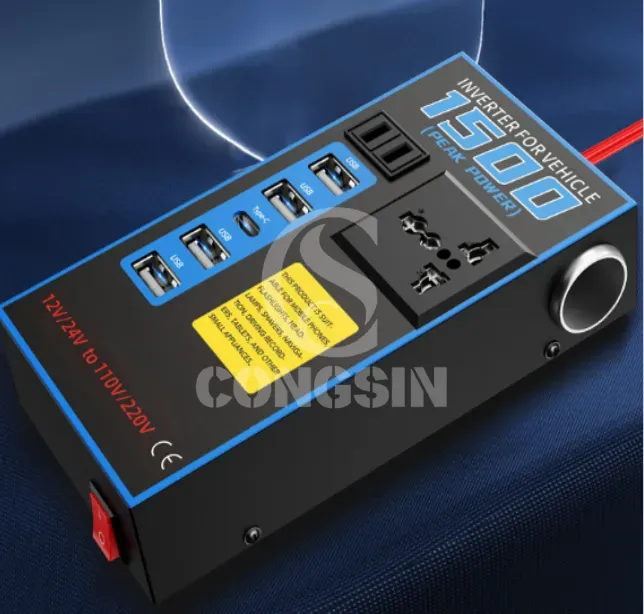
Congsin 1500W Inverter for Vehicle DC 12V/24V to AC 110V/220V with Universal socket Modified Sine Wave
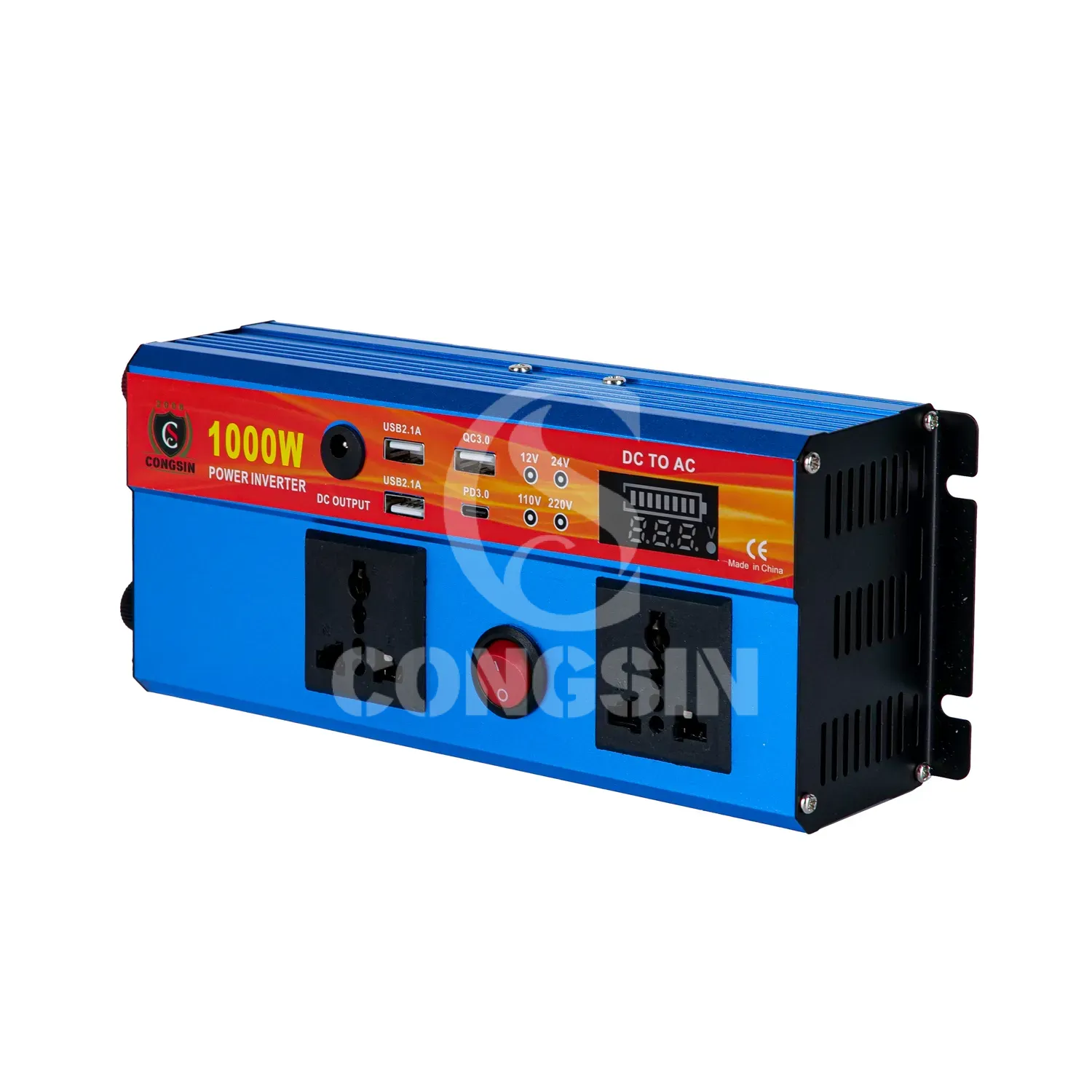
Congsin 1000W modified sine wave inverter with LED display and Type C port car RV power inverter
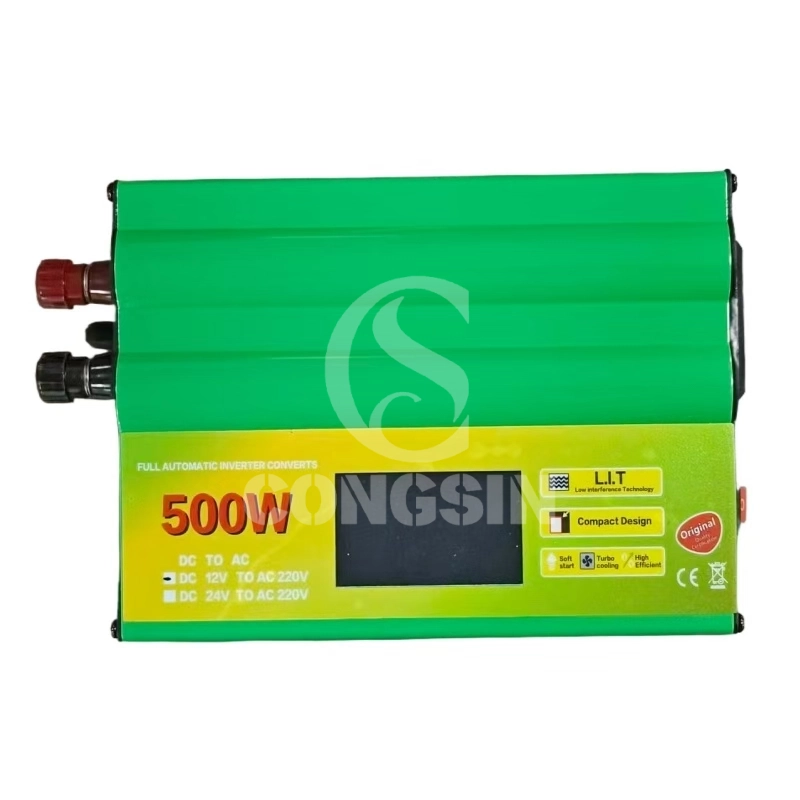
Congsin Modified Sine Wave Inverter 500W 1000W 1500W 12V LED Display Portable for RV Car Solar
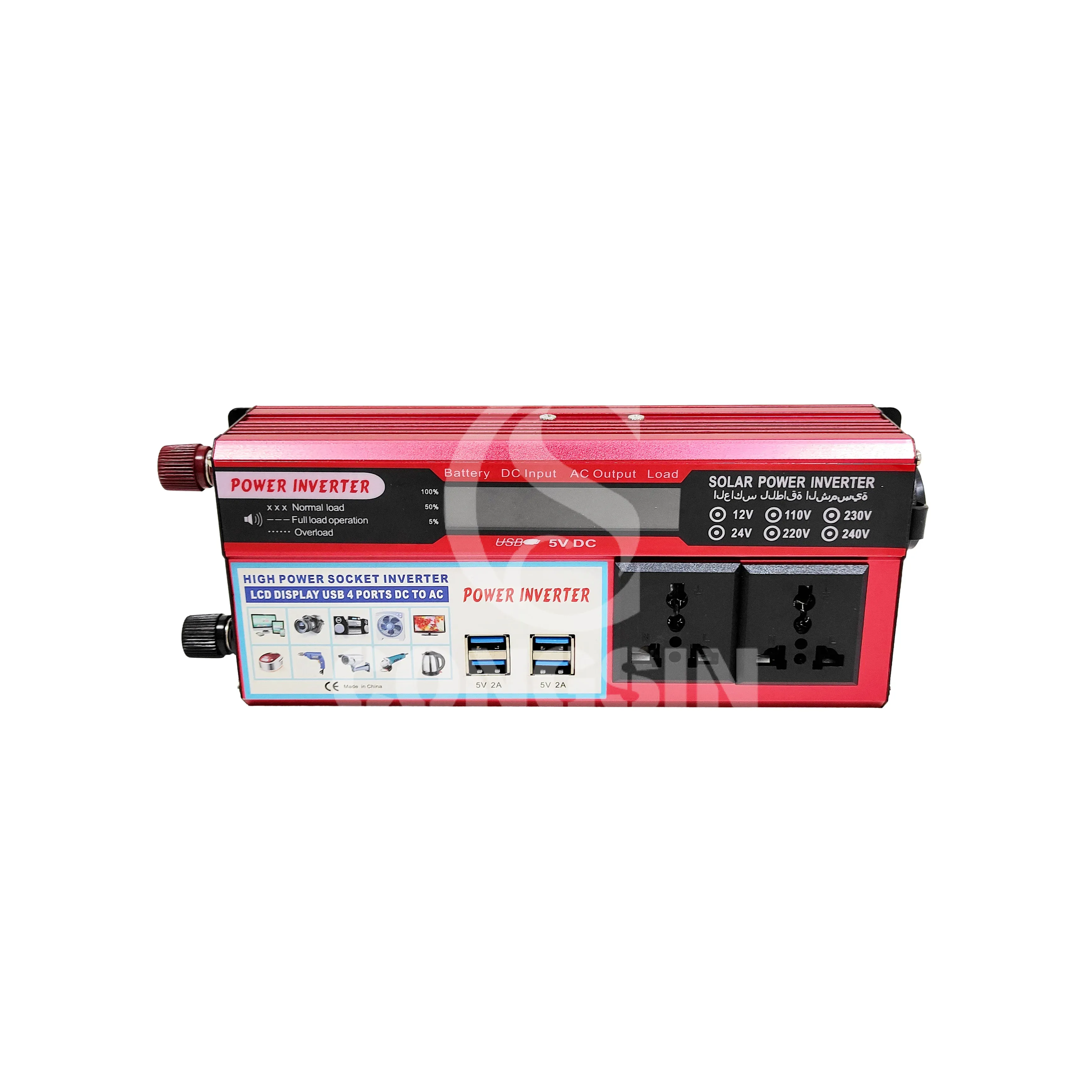
Congsin 1500W modified sine wave inverter with LCD display and USB ports for RV car boat home use

CONGSIN is a trusted OEM factory for power inverters, solar charge controllers, and DC converters. Reliable solutions for global B2B buyers.
 High Quality
 7/24 Service
 Guaranteed Warranty
© 2025 Congsin. All Rights Reserved.